

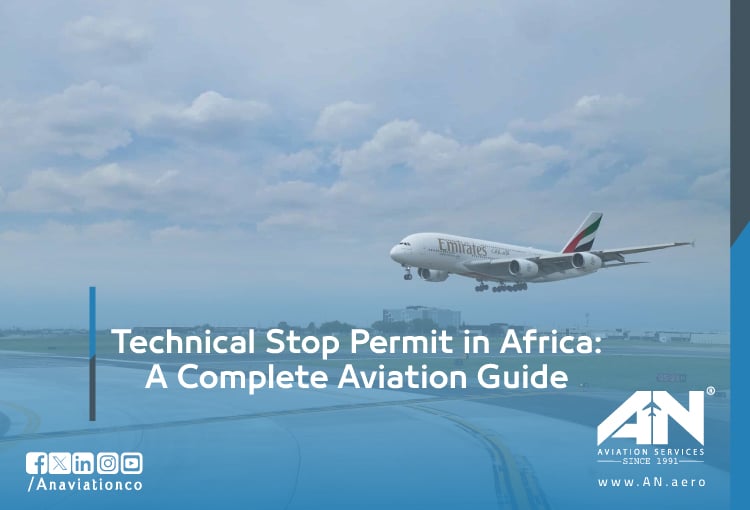
In global aviation, even the shortest landing can trigger a complex regulatory process. A technical stop often lasting less than an hour may seem operationally simple, but across Middle and South Africa, it still requires formal approval in the form of a technical stop permit.
Operators who assume otherwise often face unexpected delays, compliance issues, or financial penalties. Whether you’re operating a private jet, charter flight, or cargo aircraft, understanding how technical stop aviation permits work is essential for uninterrupted operations across the region.
What Is a Technical Stop?
A technical stop is a non-commercial landing strictly for operational purposes. These stops are planned or sometimes unplanned and are limited in scope.
Typical purposes include:
- Refueling
- Crew rest or rotation
- Minor maintenance checks
- Operational adjustments (weather rerouting, airspace restrictions)
What makes a technical stop unique is what doesn’t happen:
- No passenger boarding or disembarkation
- No cargo loading or unloading (except essential supplies like catering or spare parts)
- No commercial activity of any kind
Even though the aircraft is on the ground, it is legally considered to be in transit, which is why a specific aviation permit is still required.
Why Tech Stops Are Common in Middle & South Africa?
Technical stops are not just common in Africa; they are often unavoidable. The region presents unique operational realities that make technical stop permits a routine requirement:
1. Long Distances Between Major Routes
Flights connecting Europe, the Middle East, and Southern Africa often exceed the range of many aircraft, especially under adverse conditions like strong headwinds.
2. Limited Fuel Infrastructure in Certain Areas
Not all airports provide reliable Jet A-1 fuel availability, making it necessary to plan fuel stops strategically.
3. Restricted or Congested Airspace
Political or military restrictions in certain regions may force rerouting, increasing flight distance and fuel consumption.
4. Operational Limitations at Airports
Many airports across Africa:
- Are not open 24/7
- Have limited ground handling services
- Require prior coordination even for short stops
These factors make technical stop aviation permits a critical part of pre-flight planning.
Tech Stop vs. Landing Permit: What’s the Difference?
Understanding this distinction is one of the most important compliance factors in African aviation.
Tech Stop Permit: The Limited Version
A technical stop permit strictly authorizes:
- Landing for fuel, crew rest, or minor maintenance
- No passenger movement (passengers must remain onboard)
- No cargo operations beyond essentials
- Short ground time (typically 30–120 minutes)
- Continuation of the same flight under the same flight number
It is designed for non-commercial, transit-only operations.
Full Landing Permit: The Commercial Version
A landing permit allows full operational activity, including:
- Passenger embarkation and disembarkation
- Cargo loading and unloading
- Charter or commercial operations within the country
This type of aviation permit requires significantly more documentation, such as:
- Passenger manifests
- Customs and immigration clearance
- Ground handling agreements
- Sometimes, overflight and route approvals
Why the Distinction Matters?
Failing to classify your stop correctly can have serious consequences.
Operational Impact
- Tech stop permits are typically processed faster (sometimes within hours)
- Landing permits may take 24–72 hours or longer, depending on the country
Financial Impact
- Tech stops are cheaper due to limited services
- Full landing permits involve higher fees and additional charges
Legal & Compliance Risks
Using a technical stop permit for a commercial activity, such as allowing passengers to disembark, can result in:
- Immediate fines
- Aircraft grounding
- Revocation of future aviation permits
- Increased scrutiny for future operations in the region
When Do You Need a Tech Stop Permit?
1. Long-Haul Flights Exceeding Aircraft Range
Aircraft flying routes such as Europe to Southern Africa often require fuel stops due to range limitations or weather conditions.
2. Unforeseen Operational Needs
Diversions due to weather, medical emergencies, or airspace closures may require an urgent technical stop aviation permit.
3. Crew Duty Time Limitations
Regulations on crew working hours may require a stop for rest or crew change even if passengers remain onboard.
Pinpoint Problems & Your Action Plan
Scenario 1: Unexpected Fuel Stop
Problem:
Your aircraft cannot reach its destination due to strong headwinds. No prior permit has been arranged.
Expanded Action Plan:
- Immediately contact a flight support provider
- Provide updated routing and fuel calculations
- Confirm zero passenger movement
- Prepare documentation (AOC, insurance, schedule)
Result:
AN Aviation Services can secure a technical stop permit within 30 minutes to 2 hours for urgent operational cases.
Scenario 2: Passenger Requests to Disembark
Problem:
A passenger insists on leaving the aircraft during a fuel stop.
Expanded Action Plan:
- Brief passengers before landing to avoid misunderstandings
- Coordinate with ground handling and immigration in advance
- If disembarkation is unavoidable (e.g., medical emergency), request a permit upgrade immediately
Key Insight:
Even one passenger stepping off the aircraft can legally convert the stop into a full landing operation.
Scenario 3: Mandatory Local Handling
Problem:
Certain countries require a licensed ground handler even for technical stops.
Expanded Action Plan:
- Pre-arrange a local handler before departure
- Confirm fuel, GPU, and ground support availability
- Ensure local aviation authorities authorize the handler
Scenario 4: Airport Availability Issues
Problem:
The airport is closed during your scheduled arrival time.
Expanded Action Plan:
- Verify NOTAMs and operating hours
- Identify 24/7 alternates
- Adjust flight schedule proactively
What You Need for a Tech Stop Permit Application?
I. Core Documents (Always Required)
To obtain a technical stop permit, operators must provide:
- Valid Air Operator Certificate (AOC) or aircraft registration
- Insurance certificate meeting local liability requirements
- Full flight schedule (UTC timing is often required)
- Declaration confirming no passenger or cargo activity
II. Country-Specific Requirements
Each country adds its own layer of complexity:
- Nigeria: Requires a local handling agent for all stops
- South Africa: May require passenger manifest submission even if no one disembarks
- Kenya: Typically, processes are permitted within 24 hours, but weekend requests require prior coordination
III. The “No Traffic” Declaration
One of the most important compliance elements in a technical stop aviation permit is the “No Traffic” declaration.
This document formally confirms:
- No commercial activity will occur
- No passengers will board or leave
- No cargo will be handled
Authorities rely heavily on this declaration, and violations can lead to immediate enforcement actions.
How AN Aviation Services Handles Tech Stop Permits?
We prepare and verify all required documents in advance, minimizing back-and-forth with authorities. Unexpected stop? Our team operates around the clock to secure technical stop permits within tight timeframes.
We coordinate with trusted ground handlers across Middle and South Africa to ensure seamless operations and compliance. Each country has different rules, and we navigate them efficiently to prevent delays or rejections.
Final Thoughts
A technical stop permit may seem like a minor administrative step, but in reality, it is a critical component of safe and compliant flight operations across Africa.
Understanding when you need a technical stop aviation permit, how it differs from a full landing permit, and how to handle unexpected scenarios can save time, money, and operational risk.
With the right planning and the right partner, your technical stops can remain exactly what they should be: quick, efficient, and problem-free.