

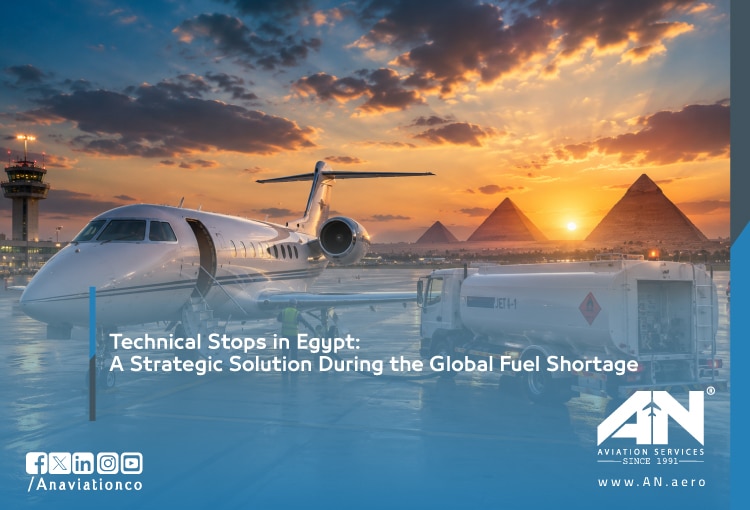
Fuel availability has become a growing operational concern for aviation in 2026.
Disruptions to global energy supply routes, rising jet fuel costs, and uncertainty at traditional refueling locations are forcing operators to reconsider how they plan long-distance flights. For private jets, cargo aircraft, and air ambulance missions, carrying additional fuel is not always the best solution because it can reduce payload capacity and increase operating costs.
This is where technical stops in Egypt can play an important role.
With its strategic position connecting Europe, Africa, the Middle East, and Asia, Egypt provides operators with a practical location to refuel, manage payload requirements, and continue long-range operations.
What Is a Technical Stop?
A technical stop is a planned landing, usually for refueling, before an aircraft continues to its final destination. It can help operators carry less fuel, preserve payload capacity, extend flight range, and improve flexibility on long-distance routes.
For private and business aircraft, a well-planned fuel stop can be completed efficiently when fuel, permits, and ground handling are arranged in advance.
The Global Fuel Crisis Is Changing Flight Planning in 2026
Fuel disruptions in 2026 have made reliable refueling options increasingly important. Disruption through the Strait of Hormuz affected nearly 21% of global seaborne jet fuel supply, while major U.S. airlines spent around $1.8 billion more on fuel in March than in February.
As fuel availability and costs become less predictable, operators are increasingly using technical stops as part of their contingency planning rather than relying only on traditional refueling locations.
Why Egypt Is a Strategic Choice for Technical Stops?
Geography gives Egypt a major advantage.
Located between Africa, the Mediterranean, and the Middle East, with direct proximity to major routes connecting Europe and Asia, the country can serve as a practical intermediate point for aircraft moving across several regions.
A technical stop in Egypt can be particularly relevant for operations such as:
- Europe to Africa: Aircraft heading deeper into Africa can use Egypt as an intermediate refueling point depending on route and aircraft requirements.
- Europe to the Middle East or Asia: Egypt can provide an alternative technical-stop option when traditional regional fuel locations face availability or routing constraints.
- Africa to Europe: Cargo, private, and medical flights originating in African markets may benefit from an Egyptian stop before continuing north.
- Special missions: Charter, cargo, air ambulance, and repositioning flights often require greater flexibility than scheduled commercial operations.
The value is not simply having somewhere to land. Operators need fuel availability, permits, handling, and turnaround services coordinated before the aircraft arrives.
That is where advance planning becomes essential.
Common Fuel-Stop Challenges and What Operators Can Do
Fuel Shortages at Usual Stops
Supply disruptions and sudden demand can make traditional fuel stops less reliable.
What to do: Add suitable Egyptian airports to your contingency plan and confirm availability before departure.
Unpredictable Fuel Prices
Global energy disruptions can cause jet fuel prices to change quickly, making costs harder to forecast.
What to do: Request current fuel quotations in advance. AN Aviation Services can coordinate fuel arrangements before arrival.
More Fuel Means Less Payload
Carrying extra fuel adds weight and can reduce available capacity for passengers or cargo.
What to do: Consider a technical stop in Egypt to optimize fuel uplift and payload, particularly for cargo operations.
Limited Visibility Into Fuel Availability
Fuel may normally be available at an airport, but the required quantity is not always guaranteed.
What to do: Pre-confirm fuel and handling arrangements and prepare alternative options before departure.
Changing Sustainability Requirements
SAF is becoming increasingly important, but availability still varies significantly between markets and airports.
What to do: Track SAF developments in Egypt while verifying airport-specific availability for each operation.
Understanding Egypt’s Fuel Supply Situation
Egypt itself operates within a challenging global energy environment.
Domestic natural gas production has declined from earlier peaks, increasing the country’s need for imported LNG to support electricity generation and domestic energy demand.
Egypt has responded by expanding its LNG procurement. In 2025, the country agreed to purchase up to 150–160 LNG cargoes through 2026, according to Reuters, as it worked to secure energy supplies amid declining domestic gas production and rising demand.
However, there is an important distinction for aircraft operators:
- Natural gas and LNG supply are not the same as aviation jet fuel availability.
- A country can face pressure in one part of its energy system while maintaining supply in another. Therefore, operators should not assume that broader reports about Egypt’s natural gas situation automatically indicate whether Jet A-1 is available at a particular airport.
- The practical approach is airport-specific planning.
Before every technical stop in Egypt, operators should confirm:
- Fuel type and required quantity, current availability, uplift arrangements, applicable pricing, payment requirements, ground handling, permits, and expected turnaround conditions.
- This provides a more reliable basis for flight planning than depending solely on national-level energy headlines.
Egypt’s Growing LNG Import Strategy
Egypt has significantly expanded its reliance on LNG imports as domestic gas production has declined.
Reuters reported in 2025 that Egypt had arranged purchases of up to 160 LNG cargoes through 2026. By July 2026, the country was also exploring longer-term agreements with major global energy suppliers as part of efforts to improve supply stability.
These developments demonstrate how quickly global energy conditions can change.
For aviation operators, they reinforce a broader operational principle: fuel planning should include alternatives.
Technical stops should therefore be selected based not only on geography, but also on verified fuel availability, route efficiency, airport capabilities, and the ability to coordinate services before arrival.
How Does a Technical Stop in Egypt Work?
A successful technical stop depends heavily on preparation.
Step 1 – Determine Whether You Need a Technical Stop
The operator first evaluates the aircraft’s range, payload, route, weather conditions, fuel reserves, destination requirements, and available fuel along the journey.
A technical stop may be required because of aircraft range, or it may be selected strategically to improve payload or fuel planning.
Step 2 – Choose the Right Egyptian Airport
The best airport depends on the route and operational requirements.
Factors may include airport operating hours, runway suitability, fuel availability, ground handling capabilities, permits, parking requirements, customs or immigration needs, and proximity to the planned flight path.
Step 3 – Coordinate With AN Aviation Services Before Departure
Advance coordination allows key arrangements to be confirmed before the aircraft leaves its origin.
Depending on the operation, this can include fuel coordination, ground handling, permits, airport services, catering, transportation, and other flight-support requirements.
Step 4 – Arrival, Refueling, and Turnaround
Once the aircraft lands, the goal of a technical stop is generally to complete the required services efficiently.
When arrangements have been made in advance, ground teams can coordinate refueling and required support to reduce unnecessary delays.
Turnaround time will vary depending on the airport, aircraft, fuel uplift, permits, and services required.
Step 5 – Departure
After refueling and required ground procedures are completed, the aircraft can continue to its next destination.
Centralized coordination can also simplify communication between the operator, airport, fuel provider, and other service partners involved in the stop.
Which Aircraft Benefit Most From Technical Stops in Egypt?
Private Jets and Business Aircraft
Long-range business jets such as the Gulfstream G650/G700, Bombardier Global 7500, and Dassault Falcon 8X are capable of operating extremely long sectors.
However, maximum published range does not mean every mission should be flown nonstop.
Payload, winds, weather, reserves, airport conditions, and fuel economics all influence real-world flight planning.
For certain Europe-Africa, Africa-Asia, or other intercontinental missions, a technical stop in Egypt may provide greater operational flexibility or more efficient fuel planning.
Cargo Aircraft
Fuel and payload decisions are especially important in cargo aviation.
Aircraft such as the Boeing 747-8F and Airbus A330-200F, as well as heavy and oversized cargo aircraft, may benefit from strategically planned refueling stops depending on payload and route requirements.
Carrying more fuel increases aircraft weight. On some missions, scheduling an intermediate fuel stop can allow operators to optimize the balance between fuel requirements and commercial payload.
Egypt’s geographic position can make it particularly relevant for cargo movements connecting Africa, Europe, Asia, and the Middle East.
Air Ambulance Flights
Medical flights often operate under demanding schedules and may need to connect destinations that are not served by direct commercial routes.
Depending on aircraft range and mission requirements, an air ambulance technical stop in Egypt can support medical repatriation and patient-transfer flights between Africa, Europe, and the wider Mediterranean and Middle East regions.
These missions require careful coordination because speed, permits, ground handling, fuel, and patient-related requirements may all be time-sensitive.
How AN Aviation Services Supports Technical Stops in Egypt?
A technical stop may look simple: land, refuel, and depart.
Behind that short turnaround, however, several services may need to work together.
AN Aviation Services supports operators in coordinating technical stops in Egypt, helping manage the operational requirements needed before and during the aircraft’s arrival.
Depending on the mission, support can include:
- Fuel coordination and availability checks.
- Ground handling arrangements.
- Landing and overflight permit coordination.
- Airport and ramp services.
- Flight support requirements.
- Crew and passenger assistance when required.
- Catering and transportation coordination.
- Support for private, cargo, charter, and air ambulance operations.
Working with one local aviation support provider can reduce the need for operators to coordinate separately with multiple parties.
It also provides a local point of contact when operational conditions or fuel requirements change.
Plan Your Technical Stop in Egypt With Confidence
The global fuel shortage has shown how quickly established aviation plans can be disrupted.
Fuel that was previously easy to source may become limited. Prices can change rapidly. Traditional refueling airports may face pressure, and carrying additional fuel from origin can affect payload and operating efficiency.
For operators flying between Europe, Africa, the Middle East, and Asia, Egypt offers a strategically positioned option for technical stops and contingency planning.
The key is arranging everything before the aircraft arrives.
With AN Aviation Services coordinating fuel, ground handling, permits, and other operational requirements, operators can plan their technical stop in Egypt with greater visibility and keep their flights moving when global fuel conditions become unpredictable.
Planning an upcoming flight through Egypt? Contact AN Aviation Services to coordinate your technical stop, confirm fuel availability, and arrange the required ground support before departure.