

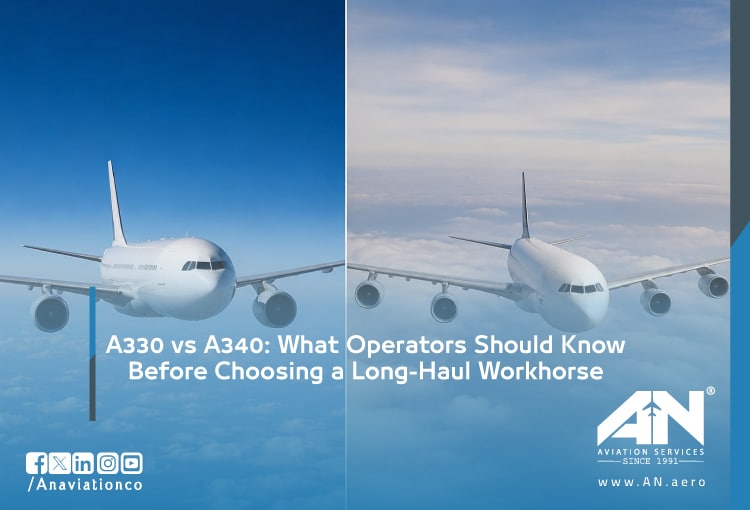
In the world of long-haul aircraft, few comparisons are as significant as the Airbus A330 and A340. These two aircraft families were developed side by side, sharing the same design philosophy, cockpit layout, and many structural components. Despite this shared heritage, they were built to solve very different operational challenges.
For operators in Egypt and across Africa, understanding the practical differences between the A330 and A340 is essential. The decision is not simply technical—it directly affects operating costs, route planning, fleet flexibility, and long-term profitability. This guide breaks down those differences in a clear, operationally focused way.
The Core Difference: Two Engines vs. Four Engines
Engine Count Dictates Mission Profile
The defining distinction between the A330 and A340 is the number of engines:
- A330: Twin-engine aircraft
- A340: Four-engine aircraft
This difference shapes how each aircraft performs and where it is most effective.
The A330 is designed for efficiency. With two powerful engines, it can operate long-haul routes while consuming significantly less fuel. Advances in ETOPS (Extended-range Twin-engine Operational Performance Standards) have allowed the A330 to fly safely over long overwater and remote routes that were once restricted to four-engine aircraft.
The A340, on the other hand, was developed in an era when such regulations were more restrictive. Its four engines allowed it to operate ultra-long-haul routes without ETOPS limitations, making it ideal for flights over remote regions where diversion airports were scarce.
The Practical Impact on African Operations
Africa presents a unique operating environment for long-haul aircraft. Large distances, limited infrastructure in some regions, and challenging geography all influence aircraft selection.
Historically, the A340’s four-engine configuration provided operators with added confidence when flying over remote areas such as the Sahara Desert or central African regions where alternate airports may be limited.
However, operational priorities have shifted. Today, the A330 is widely preferred due to its efficiency. Lower fuel consumption directly reduces operating costs, which is particularly important on high-frequency routes such as:
- North Africa to Europe
- West Africa to the Middle East
- East Africa to Asia
In these markets, the A330’s cost advantages significantly outweigh the redundancy benefits of the A340.
Fleet Commonalities: The Crew and Maintenance Advantage
One of the strongest advantages of the A330 and A340 families is their high level of commonality.
85% Parts Commonality
A large proportion of systems, components, and cockpit interfaces are shared between the two aircraft. This reduces the complexity of operating a mixed fleet and simplifies logistics for spare parts and maintenance.
Cross-Crew Qualification (CCQ)
Pilots trained on one aircraft can transition to the other with minimal additional training. This flexibility allows operators to optimize crew scheduling and reduce training costs, particularly in mixed-fleet environments.
The Maintenance Reality Check
Despite their similarities, there are important differences in long-term support:
- The A330 continues to benefit from strong global demand, ensuring stable parts availability and ongoing manufacturer support.
- The A340, which is no longer in production, is gradually facing reduced parts availability and a shrinking support network.
This has become a key consideration for operators evaluating long-term fleet investments.
Variants Comparison: Which Does What?
A330-200 vs. A340-200: Long, Thin Route Specialists
The A330-200 and A340-200 were both designed for routes with lower passenger demand but longer distances.
A330-200
Offers a strong range and efficiency, making it suitable for routes with moderate demand. It remains in active service with many operators worldwide.
A340-200
Provides a slightly greater range but has largely been retired from passenger operations due to its higher operating costs.
In today’s market, the A330-200 is the more practical and widely used option.
A330-300 vs. A340-300: Efficiency vs. Extended Reach
These two variants represent the most commonly compared models.
A330-300
Designed for high-demand routes, it is widely used on regional and intercontinental sectors. It offers an excellent balance between capacity and efficiency.
A340-300
Provides additional range, enabling longer non-stop routes. However, this capability comes at the cost of significantly higher fuel consumption.
For most operators, especially those operating within Africa and nearby regions, the A330-300 delivers superior economic performance.
The Heavy Haulers: A340-500 and A340-600
The larger A340 variants were developed for specific high-capacity and ultra-long-haul missions.
A340-500
Built for ultra-long-range operations, it was once used on some of the world’s longest flights. Today, it has largely been retired from commercial passenger service.
A340-600
Known for its long fuselage and high seating capacity, it was designed for high-density long-haul routes. However, its operating costs have limited its competitiveness in the modern market.
While these aircraft represent important milestones in aviation, they are rarely the most efficient choice for operators today.
The “Five APUs” Problem: Why the A340 Struggles
Within the aviation industry, the A340 has earned the nickname “five APUs,” reflecting perceptions about its engine efficiency.
The Operational Consequence
Operating four engines instead of two leads to:
- Higher fuel consumption
- Increased maintenance requirements
- Greater overall operating costs
As fuel prices and efficiency demands have become more critical, these factors have significantly reduced the A340’s competitiveness compared to modern twin-engine aircraft like the A330.
Cargo Capabilities: Bellyhold Operations
Both the A330 and A340 offer valuable cargo capacity through their bellyhold compartments.
- A330-300: Widely used for combined passenger and cargo operations, offering strong and efficient freight capability.
- A340-300: Provides similar cargo space but is less efficient due to higher fuel and operating costs.
For cargo operators, the ability to move freight efficiently is often more important than marginal differences in capacity, making the A330 the preferred choice in most scenarios.
Pinpoint Problems and Action Plans for Operators
Fleet Planners
The lower acquisition cost of the A340 can appear attractive, especially in the secondary market. However, this can be misleading when viewed in isolation.
Operators should focus on the total cost of ownership, including fuel, maintenance, and operational efficiency over time. In most cases, the higher operating costs of the A340 offset any initial savings within a relatively short period.
AN Aviation Services provides detailed operational and cost analysis tailored to African route networks, helping operators make informed decisions.
Cargo Operators
While the A340 offers solid cargo capacity, the long-term availability of spare parts is becoming a concern.
Before committing to an A340, operators should carefully evaluate maintenance support and supply chain reliability. Access to experienced maintenance providers is essential.
AN Aviation Services can connect operators with trusted MRO partners that continue to support A340 fleets.
Air Ambulance and VIP Charter Operators
Some clients associate four-engine aircraft with higher safety, particularly on remote routes. While this perception still exists, modern twin-engine aircraft are highly capable and meet strict international safety standards.
Operators should evaluate actual mission requirements rather than relying on perception alone. The A330 often provides a better balance of efficiency and capability.
AN Aviation Services supports operators with route planning, ETOPS considerations, and mission-specific optimization.
Mixed-Fleet Operators with Pilots
For operators running both A330 and A340 aircraft, the shared type rating offers a significant advantage.
By leveraging cross-crew qualification, operators can increase scheduling flexibility and reduce training costs. This can lead to more efficient crew utilization and improved operational resilience.
AN Aviation Services can assist in structuring crew planning strategies that maximize this advantage.
How AN Aviation Services Optimizes Support for These Aircraft?
Operating long-haul aircraft in Egypt and across Africa requires specialized expertise and regional knowledge. The shared design of the A330 and A340 allows for streamlined ground handling procedures, reducing complexity and improving turnaround efficiency.
Each aircraft has different fuel performance characteristics. Optimizing fuel planning based on aircraft type, route, and local conditions is essential for cost control.
Navigating African airspace requires careful coordination. AN Aviation Services ensures efficient permit acquisition and route optimization, helping operators avoid delays and unnecessary costs.
Final Considerations for A330 and A340 Operators
The A330 and A340 represent two different approaches to long-haul aviation.
The A340 was built for a time when operational flexibility and range were the primary concerns. The A330 reflects a more modern focus on efficiency, cost control, and adaptability.
For most operators in Egypt and Africa, the A330 offers clear advantages in today’s operating environment. However, each operation has unique requirements, and the right choice depends on specific mission needs.
AN Aviation Services provides the expertise, regional insight, and operational support needed to help operators select and manage the right aircraft for long-term success.