

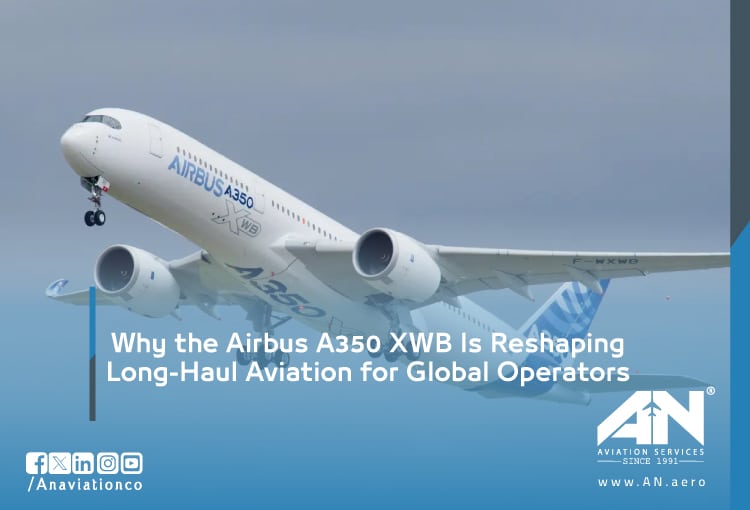
In today’s aviation industry, success depends on far more than aircraft range alone. Operators now face increasing pressure to balance passenger comfort, route efficiency, airport compatibility, permit complexity, and long-term operating costs.
For airlines, charter companies, VIP operators, cargo providers, and air ambulance services expanding across Africa, the Middle East, Asia, and Europe, the Airbus A350 XWB offers a powerful solution.
But unlocking its full operational value requires more than simply acquiring the aircraft. It demands strategic route planning, regulatory expertise, airport compatibility analysis, and operational support areas where AN Aviation Services plays a critical role.
What Does Airbus A350 XWB Mean?
“XWB” stands for Extra Wide Body, and this design directly enhances both passenger experience and operator flexibility.
The A350’s wider fuselage allows for:
- Wider seats
- Larger aisles
- Improved shoulder room
- More cabin layout flexibility
- Enhanced premium cabin opportunities
For operators, this means the ability to optimize cabin configurations while maintaining superior comfort standards on long-haul routes.
Why Passenger Experience Matters More Than Ever?
For operators targeting premium markets such as business travelers, VIP clients, and medical transport, passenger experience has become a direct commercial advantage. Comfort and onboard environment now play a key role in customer satisfaction, brand positioning, and long-haul route success.
The Cabin That Changed Passenger Expectations
The Airbus A350 was designed around passenger comfort from the ground up. Its extra-wide fuselage, advanced materials, and modern cabin architecture create a noticeably more spacious and refined onboard experience, setting a new benchmark for long-haul travel.
Lower Cabin Altitude: A Healthier Travel Experience
Thanks to its composite fuselage, the A350 maintains a cabin altitude of around 6,000 feet, compared to 8,000 feet on traditional aircraft. This allows for better pressurization and a more comfortable environment.
In practical terms, passengers arrive less tired, experience fewer headaches, and suffer less jet lag an important advantage on ultra-long-haul routes where passenger wellbeing directly impacts satisfaction.
The Quietest Twin-Aisle Cabin in the Sky
The A350 offers one of the quietest cabins in commercial aviation, with noise levels up to 9 dB lower than competing aircraft, which can feel up to four times quieter to passengers.
This creates an environment ideal for rest and productivity. For VIP and premium travelers, particularly on AN Aviation-supported charters, it means better sleep quality and the ability to work comfortably throughout the flight.
Advanced Air Quality Systems: Consistent Comfort at Altitude
Cabin air on the A350 is fully refreshed every 2 to 3 minutes, with approximately 20% more fresh air than comparable aircraft. Multiple temperature zones up to eight for passengers and additional zones for crew ensure consistent comfort throughout the cabin.
This results in a fresher, more controlled environment, enhancing passenger comfort while also supporting sensitive operations such as medical and air ambulance missions.
Full LED Ambient Lighting: Supporting Passenger Wellbeing
The A350 features advanced LED lighting with 16.7 million color combinations, allowing dynamic lighting scenarios that simulate natural sunrise and sunset cycles.
These lighting transitions help regulate circadian rhythms, reducing the impact of jet lag and improving overall passenger well-being on long-haul flights.
Larger Cabin Space: Practical Comfort Gains
The aircraft also maximizes usable space through 95-inch-high cabin walls, the highest in its class, and vertical sidewalls that increase shoulder room. Combined with larger overhead bins, this design makes the cabin feel more open and comfortable even for passengers in window seats.
Airbus A350 Performance Advantages for Global Operators
Performance That Makes Ultra-Long-Haul Possible
The Airbus A350 family is engineered to deliver exceptional range and efficiency, enabling true ultra-long-haul operations. The A350-900 offers a range of up to 15,000 km (8,100 nautical miles) with capacity for 300 to 350 passengers, making it ideal for balanced long-haul routes. The larger A350-1000 extends this capability to 16,100 km (8,700 nautical miles) while accommodating up to 410 passengers, targeting higher-demand markets.
For more demanding missions, the A350 ULR (Ultra Long Range) can reach up to 17,964 km (9,700 nautical miles), enabling flights exceeding 20 hours non-stop and unlocking direct connections between distant global regions.
The Engine Behind the Performance
Powering the A350 is the Rolls-Royce Trent XWB engine, purpose-built for this aircraft. The Trent XWB-84 produces up to 84,000 lbs of thrust, while the Trent XWB-97 powers the A350-1000 with higher thrust for increased capacity and range performance.
Ongoing advancements continue to improve efficiency. The enhanced Trent XWB-84 EP variant, certified by EASA, delivers additional fuel savings, contributing to improved long-haul economics, better fuel efficiency, and reduced maintenance burden over time.
Fuel Efficiency: The Operating Cost Advantage
The Airbus A350 delivers around 25% lower fuel burn and CO₂ emissions compared to previous-generation aircraft. This translates directly into lower operating costs, reduced environmental impact, and easier compliance with global emissions frameworks such as CORSIA.
For operators expanding long-haul networks, this efficiency is critical. It enables more viable non-stop routes, reduces fuel-related cost exposure, and supports long-term sustainability strategies without compromising performance..
Variants Breakdown: Which A350 Does What
A350-900: The Workhorse
The A350-900 is the most versatile variant in the family. It measures 66.8 meters in length, typically seats 300 to 350 passengers in a three-class configuration, and is certified for up to 283 tonnes MTOW in its latest versions.
Its balanced range and capacity make it ideal for long-haul routes such as Cairo–Beijing, Dubai–Sydney, and Addis Ababa–London, where operational efficiency and consistent demand are key.
A350-1000: The Extended Heavy Lifter
The A350-1000 is designed for higher-capacity, high-demand long-haul markets. At 73.79 meters in length, it accommodates 350 to 410 passengers and offers a range of 16,100 km (8,700 nautical miles). It is certified for up to 322 tonnes MTOW, supporting greater payload and extended reach.
It also provides around 40% more premium cabin space than the A350-900 while maintaining the same comfort standards, making it ideal for dense international routes and for airlines replacing older aircraft such as the A340-600.
A350 ULR: The Ultra-Long-Haul Specialist
The A350 ULR is optimized for the world’s longest routes. It features a modified fuel system that increases capacity by 24,000 liters without adding additional tanks, along with aerodynamic improvements such as extended winglets.
With an optimized 280-tonne MTOW configuration, it can operate flights exceeding 20 hours non-stop. A leading example is Singapore Airlines’ non-stop Singapore–New York service, covering 9,537 statute miles (8,287 nautical miles)—one of the longest commercial routes globally.
Airbus A350 vs Boeing 787: Strategic Operator Comparison
While both aircraft are technologically advanced, the Airbus A350 often provides:
A350 Advantages:
- Wider cabin
- Longer range
- Better premium comfort
- Quieter environment
- Stronger ultra-long-haul performance
Boeing 787 Advantages:
- Lower capacity for some route models
- Potential flexibility for smaller demand segments
Strategic Conclusion:
For operators prioritizing premium long-haul performance and broader operational capability, the A350 often provides stronger long-term value.
Pinpoint Problems & Your Action Plan for Operators
Successfully operating the Airbus A350 requires understanding a few key challenges and applying the right solutions to maximize its value.
Charter Operators
Problem: Not all airports can handle the A350, especially the larger A350-1000, creating risks for route planning and ground operations.
Solution: Identify A350-capable airports in advance. AN Aviation Services provides detailed infrastructure intelligence across Africa, the Middle East, and Asia, ensuring your routes are fully supported before operations begin.
Air Ambulance Operators
Problem: The A350-900’s ultra-long range may seem unnecessary for standard medical missions.
Solution: Use that range to eliminate refueling stops. Non-stop flights from remote regions to major medical centers improve patient safety and reduce transit time. AN Aviation supports these missions with permit coordination and fuel planning.
VIP and Private Operators
Problem: Uncertainty about whether the A350 is cost-effective compared to smaller aircraft.
Solution: Conduct a full trip cost analysis. On long-haul routes, the A350 often delivers better cost efficiency per passenger. AN Aviation Services provides detailed comparisons to guide aircraft selection.
Cargo Operators
Problem: Concerns about parts availability and maintenance support for the A350.
Solution: Leverage the aircraft’s growing global support network. AN Aviation connects operators with trusted MRO facilities to ensure reliable maintenance and operational continuity.
Ready to Optimize Airbus A350 Operations?
Planning A350 flights across Africa, the Middle East, Asia, or Europe?
AN Aviation Services provides the strategic support you need for:
- Permits
- Route planning
- Airport feasibility
- Ground operations
- Long-haul mission success
Partner with AN Aviation Services to unlock the full operational power of the Airbus A350.