

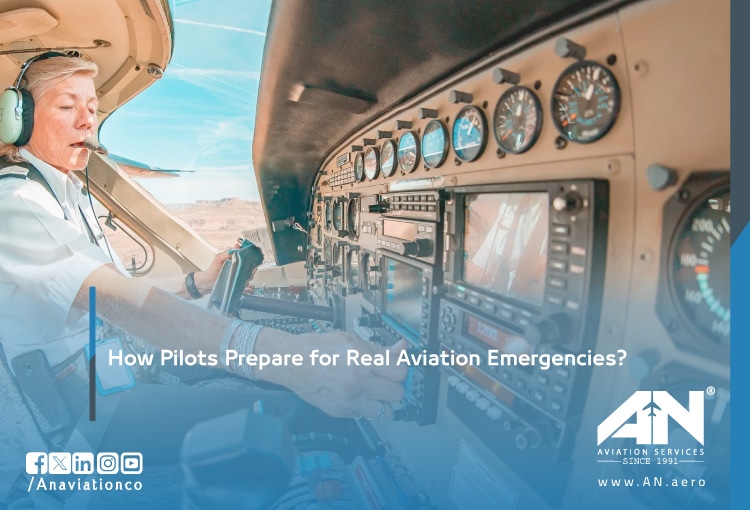
In aviation, the margin for error is almost zero. Systems are designed with redundancy, aircraft are rigorously maintained, and operations follow strict procedures, yet aviation emergencies still happen.
What separates a manageable incident from a catastrophe is not luck. It’s training.
For every pilot, the ability to respond instantly and correctly under extreme pressure is not just a professional expectation; it’s a life-saving capability. This is why emergency training is not optional, not occasional, and never “good enough.” It must be continuous, realistic, and deeply ingrained.
The Difference Between Knowledge and Muscle Memory
Every pilot learns emergency procedures during initial training. They study checklists, memorize flows, and understand system logic.
But in a real emergency:
- There is no pause button
- There is no time to “think it through” step by step
- There is no perfect environment
Stress, alarms, physical sensations, and time pressure all combine to create cognitive overload.
This is where muscle memory becomes critical.
Through repetition:
- Hands move instinctively to the correct switches
- Eyes scan the right instruments automatically
- Communication becomes structured and precise
The goal is simple: reduce reaction time and eliminate hesitation.
A well-trained pilot doesn’t just know what to do; they execute immediately.
The Foundation: Simulator Training
Simulator training allows pilots to safely practice aviation emergencies in realistic environments, building confidence, accuracy, and fast decision-making under pressure.
Full-Flight Simulators (FFS): The Gold Standard
Full-flight simulators are the backbone of modern emergency training.
Level D simulators, the highest certification level, are engineered to replicate reality with extraordinary accuracy:
- Exact cockpit layout and controls
- Realistic aircraft behavior and system responses
- Full-motion platforms that simulate turbulence, acceleration, and impact
- High-definition visuals replicating airports, terrain, and weather
This immersive environment allows pilots to experience emergencies as if they were happening in real life.
More importantly, simulators allow exposure to high-risk aviation emergencies that cannot be safely recreated in actual aircraft:
- Engine failure at V1 (critical takeoff decision speed)
- Dual engine loss at altitude
- Electrical system collapse
- Severe icing conditions
- Rapid decompression
Pilots don’t just practice procedures; they experience stress, urgency, and decision-making in a controlled environment.
Recurrent Training: Why One-Time Training Isn’t Enough?
Skill degradation is real.
Even highly experienced pilots can lose sharpness if emergency procedures are not practiced regularly.
That’s why aviation authorities mandate recurrent simulator training:
- Typically, every 6–12 months
- Includes both expected and unexpected failures
- Requires demonstration of proficiency, not just participation
During these sessions, pilots are evaluated on:
- Decision-making under pressure
- Procedural accuracy
- Communication and leadership
- Situational awareness
Recurrent training ensures that emergency handling remains instinctive, not theoretical.
Scenario-Based Training: Preparing for the Unexpected
Scenario-based training exposes pilots to unpredictable situations, helping them develop real-time problem-solving skills beyond standard checklists.
Moving Beyond Checklists
Traditional training focused heavily on memorization and checklist execution.
Modern aviation training goes further.
Today, instructors deliberately introduce unpredictable, scenario-based failures:
- Multiple system failures are occurring simultaneously
- Failures at the worst possible moment (e.g., takeoff, landing)
- Situations that evolve rapidly and require reassessment
This forces pilots to:
- Diagnose problems rather than recognizing them instantly
- Prioritize actions instead of following rigid sequences
- Adapt to changing conditions
Because in real aviation emergencies, nothing happens exactly as trained.
Crew Resource Management (CRM): The Human Factor
Many aviation incidents are not caused by technical failure but by breakdowns in communication.
CRM training addresses this by focusing on:
- Clear, concise communication
- Assertiveness from both the captain and the first officer
- Cross-checking and error detection
- Workload distribution during high-stress situations
For example:
- A first officer must feel confident in challenging a captain if something is wrong
- A captain must delegate effectively instead of becoming overloaded
Strong CRM transforms a cockpit from two individuals into a synchronized decision-making unit.
Pinpoint Challenges & Your Action Plan
For New Pilots
Challenge: Limited exposure to rare but critical emergencies.
Reality: Not all failures are equally practiced, yet some of the rarest are the most dangerous.
Action Plan:
- Actively request additional simulator scenarios
- Focus on high-impact, low-frequency events
- Treat every training session as an opportunity, not a requirement
For Corporate Flight Departments
Challenge: Lack of integrated emergency training between cockpit and cabin crew.
Why It Matters: In real emergencies, coordination determines evacuation speed and passenger survival.
Action Plan:
- Conduct joint drills involving pilots and cabin crew
- Practice communication protocols during evacuations
- Simulate real passenger management scenarios
For Operators in Remote Areas (Including Parts of Egypt & Africa)
Challenge: Limited airport emergency response capabilities.
Reality: Many training scenarios assume immediate rescue services, but this is not always the case.
Action Plan:
- Train for self-reliance scenarios
- Practice handling onboard emergencies without external support
- Prepare for medical diversions to airports with limited facilities
For Private Pilots
Challenge: Limited access to advanced simulator training.
Action Plan:
- Use desktop simulators to build procedural familiarity
- Practice emergency checklists regularly
- Attend periodic refresher courses at certified training centers
Even without full-motion simulators, consistency builds competence.
Real-World Aviation Emergencies Pilots Train For
Emergency training covers a wide range of high-risk situations, including:
1- Engine Failure at Takeoff: One of the most critical phases of flight. Decisions must be made within seconds.
2- Cabin Fire with Smoke: Smoke can incapacitate the crew quickly. Rapid identification and response are essential.
3- Loss of Pressurization: Requires immediate descent while managing passenger oxygen needs.
4- Hydraulic or Flight Control Failure: Pilots must control the aircraft with degraded or alternate systems.
5- Ditching (Water Landing): A rare but high-risk scenario requiring precise coordination and preparation.
How AN Aviation Services Enhances Pilot Preparedness?
Pre-Flight Intelligence That Matters
AN Aviation Services supports pilots operating in Egypt and beyond by providing:
- Detailed airport briefings
- Emergency response capability insights
- Operational risk assessments
This allows pilots to anticipate challenges before takeoff, not during emergencies.
Real-Time Operational Support
In the middle of irregular operations or unexpected situations, time is critical.
AN Aviation Services offers:
- Immediate coordination support
- Access to accurate, real-time information
- Assistance in managing diversions or disruptions
This extra layer of support enhances decision-making when it matters most.
Training Is the Last Line of Defense
Aircraft systems can fail. The weather can change. Situations can escalate without warning. But a well-trained pilot remains the strongest safety barrier in aviation.
Handling aviation emergencies is not about reacting; it’s about being prepared long before anything goes wrong. Because in aviation, the best outcome is not just surviving an emergency, it’s controlling it.