

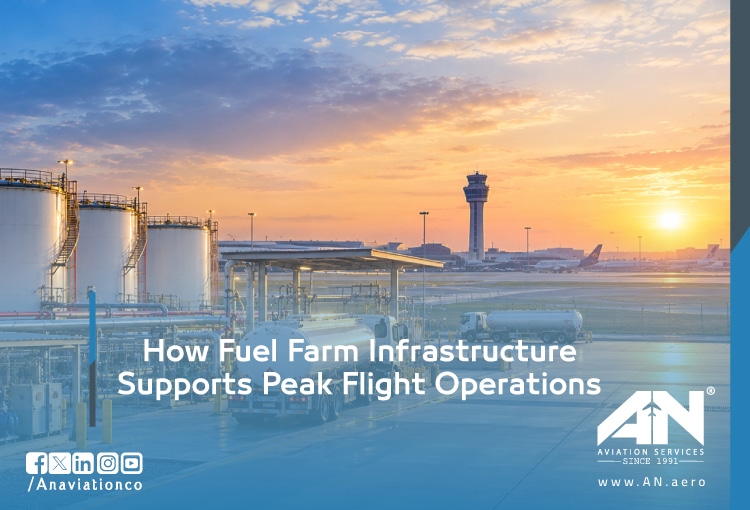
An aviation fuel farm is the storage and distribution system that keeps an airport’s aircraft fueled. During peak season, its capacity sets a hard limit on flight operations. When the fuel farm runs low, flights get delayed, cancelled, or rerouted, no matter how well everything else is planned.
Most operators only think about the fuel farm when it fails. The fuel truck is late. The supplier caps your uplift. The airport issues a NOTAM about limited fuel on your busiest weekend.
This guide explains what a fuel farm is, how it works, where peak season bottlenecks happen, and how AN Aviation Services helps you plan around them.
The Fuel Behind Every Peak Season Flight
Peak travel months bring the highest flight demand of the year. They also put the most pressure on airport fuel infrastructure.
A typical Saturday at one Florida airport required over 70,000 gallons of jet fuel to fuel 50 outbound flights. That equals nearly nine 8,000-gallon semi-trucks of fuel delivery in a single day.
Every one of those trucks has to arrive, unload, and keep pace with demand. If one link in that chain slows down, the whole schedule feels it.
What Is a Fuel Farm and Why It Matters?
A fuel farm is the airport facility that receives, stores, filters, and distributes aviation fuel. It includes storage tanks, pumps, piping, filtration systems, and the control systems that tie them together.
At larger airports, fuel farms are often run by airline consortiums or fuel service providers. At smaller airports, the FBO may operate the fuel farm directly.
Either way, the fuel farm decides how much aviation fuel is available on the ramp, and how fast it gets to your aircraft.
The Peak Season Problem You Face as an Operator
Why does this matter to you as an operator?
- You cannot fly without fuel.
- Peak season is when you make your money.
- Fuel farm limitations become your limitation.
Understanding fuel farm infrastructure helps you plan better and avoid disruptions before they reach your schedule.
How a Fuel Farm Works: The Basics You Need to Know
Storage Tanks: The Heart of the Fuel Farm
Above-ground storage tanks hold Jet-A fuel. Tanks cannot be run completely empty because of how the system operates, so net storage is always less than total capacity.
A 130,000-gallon fuel farm may have only 100,000 gallons of usable fuel at any time. On a peak day, that margin disappears quickly.
Pumps and Piping: Moving Fuel to Aircraft
- On-load pumps: Receive fuel from trucks or pipelines.
- Off-load pumps: Push fuel to hydrant systems or fuel trucks.
- Piping: Connects the tanks to the ramp where aircraft park.
Pump failures can halt all fueling operations, even when the tanks are full.
Filtration Systems: Keeping Fuel Clean
Jet fuel must meet strict quality standards. Filtration systems remove water, dirt, and contaminants before fuel reaches the aircraft.
Fuel quality issues can cause engine problems or failures, which is why regular maintenance of filtration systems and ongoing quality control are critical.
Fuel Management Systems: Real-Time Visibility
Modern fuel farms use digital control systems to track fuel volumes. Real-time tank readings show how much fuel is available, and low-level alerts help prevent runouts.
Integration with airport operations keeps fueling coordinated with arrivals, departures, and turnaround times.
Pinpoints: Where Peak Season Fuel Bottlenecks Happen?
- Pinpoint 1: Your Fuel Farm Runs Low During Peak Weekends; Demand spikes on peak weekends, and usable storage drops fast.
What to do: Know the fuel farm capacity at your destination airports and ask about their peak season plans. Contact AN Aviation Services for fuel coordination across your network.
- Pinpoint 2: Resupply Logistics Cannot Keep Up; If an airport relies on trucks alone, every late delivery hits the ramp.
What to do: Identify airports on your routes that depend on a single resupply method. Have contingency plans for fuel stops at alternate airports.
- Pinpoint 3: Pipeline Disruptions Create Immediate Fuel Crises; When a pipeline goes down, airports that depend on it can run short within days.
What to do: Monitor pipeline status for airports on your routes. Have tankering plans ready, and work with fuel providers that have diverse supply chains.
- Pinpoint 4: Fuel Farm Storage Is Below Industry Standards; Some airports operate with thin storage margins that leave little room for peak demand.
What to do: Prioritize airports with adequate fuel reserves. Avoid airports operating on thin margins during peak season.
- Pinpoint 5: Fuel Farm Expansion Takes Years; New tanks and fuel infrastructure take years to plan, approve, and build. Capacity will not catch up with demand overnight.
What to do: Support airports that are investing in fuel infrastructure, and plan your operations around airports with adequate capacity.
What You Can Do to Protect Your Peak Season Operations?
When the holiday rush hits or major events flood the skies, the difference between a profitable rotation and an expensive apron parking fee often comes down to one critical question: do you actually know where your next drop of Jet A1 is coming from?
Global operators face a perfect storm during high-traffic windows—airports from Dubai to Denver see their fuel farms drained by scheduled carriers, leaving business aviation and charter operators scrambling for scraps. If you are not treating fuel as a strategic asset rather than an afterthought, you are essentially gambling with your seasonal revenue.
- Know Your Fuel Farm Capacity at Key Airports: Find out the usable storage, resupply method, and peak season plans at the airports you depend on most. Peak season exposes the myth of universal fuel availability. That hub airport you rely on year-round may have storage tanks that empty faster than a departure queue during festival weeks or summit season. Smart operators audit actual fuel farm capacity at their critical destinations weeks in advance, not hours. Understanding the difference between theoretical supply and operational reality—knowing whether a specific FBO has 50,000 gallons or 500,000 gallons accessible—allows you to sequence your tech stops with confidence rather than hope.
- Identify Airports with Thin Fuel Margins: Flag airports that run close to empty on busy days, and treat them as higher risk in your planning. Every region has its vulnerability points: island destinations with single-supplier dependence, secondary airports that rely on daily truck deliveries, or hubs where political instability threatens supply chains. During peak operations, these thin margins collapse entirely. You need to identify which of your regular destinations become fuel deserts when demand spikes—whether that is a Caribbean island during winter escape season or a European capital during fashion week. Recognizing these chokepoints allows you to pivot to alternates with robust reserves or adjust your payload calculations before you are forced into an unplanned diversion.
- Have Contingency Fuel Plans: Plan alternate fuel stops and tankering options before peak season starts, not after a NOTAM arrives. Hope is not a fuel strategy. When your primary destination runs dry, you need pre-vetted alternates with confirmed availability, tankering strategies that account for the weight penalty versus the diversion risk, and contractual priority access where possible. This means having fuel release numbers secured at backup airports within your operational radius and understanding the logistics of fuel trucking or bowser services at remote locations. Contingency planning transforms a potential crisis into a manageable operational deviation.
- Work with a Fuel Coordination Partner: A partner who tracks fuel availability across your network can spot problems early and arrange alternatives fast. The complexity of global fuel logistics during high-demand periods requires more than a credit card and a prayer. Working with a dedicated fuel coordination partner provides you with real-time visibility into stock levels, priority allocation when supplies tighten, and the leverage of aggregated purchasing power that individual operators simply cannot match. These partners monitor geopolitical disruptions, weather events, and infrastructure failures that affect supply chains from Singapore to São Paulo, ensuring your flight plan remains viable even when local conditions deteriorate.
How Can AN Aviation Services Help with Fuel Supply During Peak Operations?
AN Aviation Services provides 24/7 aviation fuel coordination, ground handling, and flight support for operators worldwide.
- Fuel Availability Checks Before You Depart: We confirm fuel availability and uplift arrangements at your planned stops before your aircraft leaves.
- Contingency Fuel Planning: We identify alternate airports and backup fuel options, so a low fuel farm does not ground your schedule.
- 24/7 Coordination: Our operations desk works around the clock with fuel suppliers and ground handlers to keep fueling aligned with your turnaround.
Peak season is when every gallon counts. Contact AN Aviation Services to plan fuel for your next peak period.