

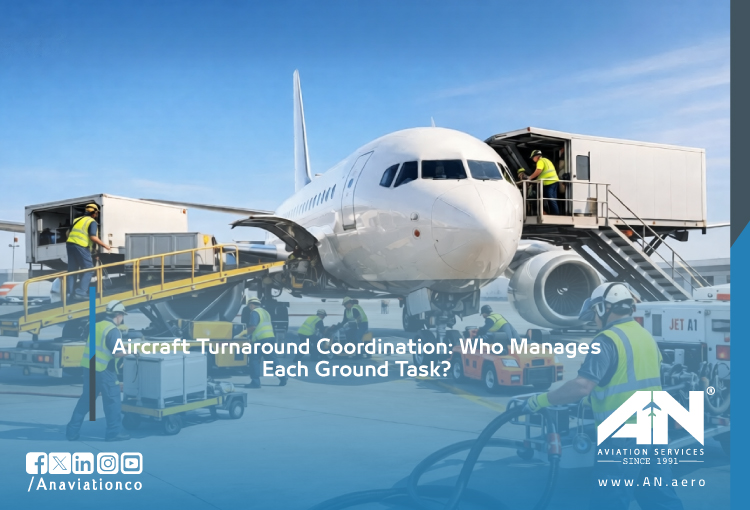
Every on-time departure depends on aircraft turnaround coordination. Dozens of ground tasks happen at once around your aircraft, and one person, the Turnaround Coordinator, is responsible for making sure they happen in the right order, at the right time, and safely.
The clock starts the moment your aircraft lands. At large airports, a typical turnaround under normal conditions takes about 55 minutes for a narrow-body aircraft and 110 minutes for a wide-body. At smaller airports, the window is tighter: about 45 minutes for a narrow-body and 90 minutes for a wide-body.
Within that window, ground handlers, fuelers, baggage teams, catering, cleaning crews, and technical staff all work in close proximity to the aircraft. The real question is not whether these tasks get done. It is who makes sure they fit together.
This guide breaks down who does what during an aircraft turnaround, and how AN Aviation Services keeps your ground operations on schedule.
What Is an Aircraft Turnaround?
An aircraft turnaround is the full set of ground handling services performed between an aircraft’s arrival on stand and its next departure.
It covers passenger disembarkation and boarding, baggage and cargo loading and unloading, fueling, catering, cleaning, water and waste services, and any required technical checks. Many of these tasks run in parallel, and some depend on others. Fueling, for example, has to be coordinated with passenger boarding, while loading cannot be finalized until the load sheet is complete.
That is why turnaround coordination matters. Without a clear owner, small delays in one ground task quickly push back the entire departure.
The Master Conductor: Who Oversees the Entire Turnaround?
The Turnaround Coordinator (TRC)
In line with industry practice, one person is nominated to take overall control of the ground handling activity for each flight: the Turnaround Coordinator.
The TRC coordinates every phase of aircraft handling, including catering, cleaning, fueling, and crew and passenger boarding. They are the main point of contact for the airline, the crew, and every service provider during the turnaround.
They also make sure each provider meets its service level agreement and that the work follows the agreed turnaround plan. If something slips, the TRC is the first to know and the first to act.
The Dispatcher
Before the aircraft arrives, the dispatcher inspects the stand and makes sure it is clear of Foreign Object Debris (FOD). During the turnaround, the dispatcher tracks progress and makes sure every task is completed within the planned time.
The Ramp Operations Manager
The ramp operations manager oversees airside operations as a whole. They plan resources, supervise ramp staff, and make sure ground handling activities stay safe, efficient, and compliant across all flights, not just one.
Phase by Phase: Who Does What During the Turnaround?
1. Pre-Arrival Phase
The turnaround starts before the aircraft lands. The dispatcher confirms the parking stand, completes the safety inspection, and checks that the right ground equipment is available. At the same time, the Turnaround Coordinator briefs every ground service provider on the plan, while the ramp team prepares the chocks, ground power unit, and airbridge or stairs.
2. Arrival and Parking Phase
As the aircraft approaches, a marshaller or visual docking system guides it onto the stand, positioning it precisely for wingtip clearance and airbridge alignment. Once it stops, ramp agents place chocks around the wheels and connect ground power. The Turnaround Coordinator then meets the cabin manager to confirm the passenger count and any special assistance needs.
3. Passenger Handling Phase
Gate agents and passenger handlers connect the airbridge or stairs and manage disembarkation, then boarding for the next flight. Load controllers confirm passenger numbers with the cabin manager, while special assistance teams coordinate with the dispatcher so passengers who need help are looked after without holding up the flight.
4. Baggage and Cargo Handling Phase
While passengers move, baggage handlers open the cargo holds, unload arriving bags, and load departing baggage and cargo. Load controllers prepare and distribute the flight documents, including the loading instructions and the load sheet. Ramp agents then reconcile what is actually in the holds against the load sheet, so the numbers match before departure.
5. Aircraft Servicing Phase
Several servicing tasks run in parallel. The fueling crew uplifts the fuel requested by the flight crew, using fuel trucks or hydrant systems where available. Catering teams load fresh meals, ice, and beverages, and the cleaning crew removes waste, cleans the cabin, and checks for lost property. Water and waste teams empty the wastewater tank and refill fresh water, while engineering staff carry out any required technical inspections or maintenance.
6. Departure Phase
Before the doors close, the Turnaround Coordinator confirms that every task is complete, verifies the fuel status, and checks headset communication with the flight deck. The dispatcher confirms the turnaround plan has been completed and reports any deviations to the relevant parties. Finally, the pushback crew moves the aircraft back safely, keeping it clear of the stand and other aircraft.
How AN Aviation Services Ensures Your Turnaround Stays On Schedule?
A turnaround is only as fast as its weakest link. AN Aviation Services brings every ground task under one coordinated plan.
1- End-to-End Turnaround Coordination: We act as your single point of contact on the ground. From stand allocation to pushback, we coordinate ground handling, fueling, catering, and passenger services so you do not have to manage multiple providers.
2- Real-Time Operational Monitoring: Our 24/7 operations team tracks your flight and each stage of the turnaround. If a delay starts to build, we flag it early and work with the relevant teams to recover time.
3- CAA-Compliant Partner Network: We work with ground service providers at airports in line with Civil Aviation Authority requirements and each airport’s operating procedures. That means safe, compliant operations at every station.
Planning a flight? Contact AN Aviation Services to coordinate your next turnaround.