

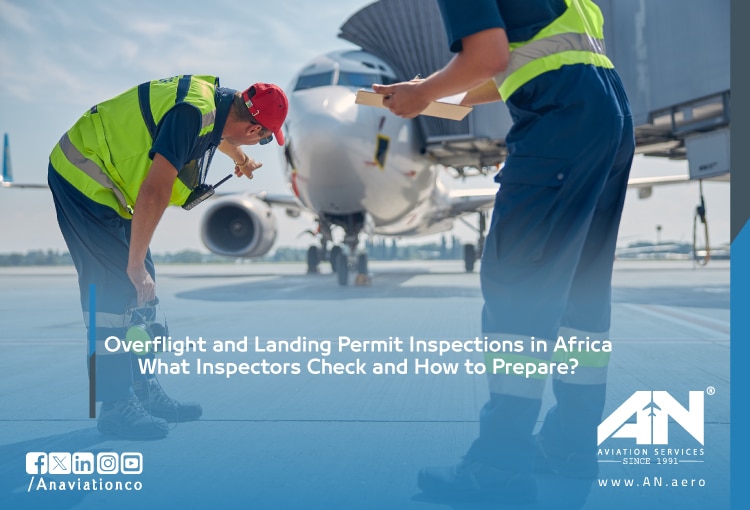
Securing an overflight or landing permit is an essential part of operating across African airspace. But obtaining the permit is only one part of the compliance process. Authorities may still inspect your aircraft, crew, and documentation before, during, or after a flight. A missing certificate, outdated document, or country-specific requirement that has been overlooked can lead to delays, denied entry, fines, or even aircraft detention.
For operators flying through Middle and South Africa, preparation matters. Understanding what authorities look for during overflight and landing permit inspections can help you avoid unnecessary disruption and keep your operation moving.
What Happens During a Permit Inspection?
Before approving an overflight or landing permit, aviation authorities may review key information about the aircraft, operator, and crew. Once the aircraft is operating, authorities can also conduct inspections to confirm that the information provided remains accurate and that the operation complies with applicable regulations.
During an inspection, authorities may review:
- Aircraft registration and airworthiness documentation
- Insurance certificates
- Crew licenses and credentials
- Operator authorizations
- Aircraft ownership documentation
- Required radio and operational documents
- Passenger and cargo information
- Copies of approved overflight and landing permissions
Inspections can take place on the ground at departure or arrival airports, or during a ramp inspection while the aircraft is parked.
Civil aviation authority inspectors may also verify compliance with applicable national regulations and international standards, including relevant ICAO requirements.
The key point is simple: having a permit does not eliminate the possibility of an inspection.
Why Are Inspections Becoming More Common?
Aviation security and regulatory controls continue to evolve. Authorities increasingly use risk-based approaches to assess aircraft, operators, passengers, and crew before allowing operations through their airspace.
Several factors contribute to increased scrutiny.
Enhanced Security Requirements: Authorities are placing greater emphasis on security assessments, identity verification, and the accuracy of information submitted during the permit process. Depending on the country and operation, this may include biometric verification, background checks, and additional security documentation.
More Detailed Permit Requirements: An aviation permit may involve more than simply notifying the relevant aviation authority. Depending on the country, operators may need political, air traffic control, financial, or other clearances before the flight can proceed. Requirements can also differ significantly between countries. Documentation that is accepted in one jurisdiction may not satisfy another.
International Regulatory Expectations: Operators flying internationally must also consider the requirements of the airspace they are entering. For example, European operations may involve additional crew and security documentation requirements under applicable European regulations. This is why relying on a standard documentation package for every flight can create problems. The route and destination matter.
The Cost of Failing an Inspection
A permit inspection is not simply an administrative formality. Failure to provide the required documentation can directly affect an aircraft’s schedule and the operator’s costs.
Incomplete or incorrect documentation can result in:
- Delays in permit processing
- Delays at departure or arrival
- Additional requests from authorities
- Denied entry
- Fines or other regulatory action
- Aircraft detention or grounding
- Disruption to passengers and clients
- Additional operational costs
- Damage to the operator’s reputation
Documentation problems can be particularly costly when they are discovered after the aircraft has already reached its destination or is preparing to enter another country’s airspace.
For operators, the objective should therefore be to identify documentation issues before the aircraft departs, rather than waiting for an inspector to find them.
AN Aviation Services has supported aviation operators with permit and regulatory requirements since 1991, helping clients prepare for the documentation and coordination involved in international operations.
What Inspectors Check and How to Prepare?
Most inspection problems can be traced back to a few common preparation gaps. Identifying them before departure can make the difference between a smooth operation and an avoidable delay.
Pinpoint 1: Your Aircraft Documentation Is Incomplete
Aircraft documentation is the foundation of an inspection. If required certificates are missing, expired, inconsistent, or unavailable, the inspection can quickly become complicated.
Action 1: Use a Complete Documentation Checklist
Before every international operation, verify that the aircraft documentation package is complete and current. This should include relevant documents such as:
- Airworthiness Certificate
- Aircraft Registration Certificate
- Radio Station License
- Minimum Equipment List (MEL) or applicable Master MEL
- Airplane Flight Manual
- Weight and balance documentation
- Aircraft and engine logbook copies where required
- Import documentation for applicable aircraft
- Operator Specifications or Letters of Authorization
- Ownership documentation
- Certificates of Insurance
Requirements can vary by jurisdiction, so the checklist should be adapted to the specific countries on the itinerary.
Pinpoint 2: You Do Not Have Trip-Specific Documentation Ready
Having valid aircraft documents is not enough. Inspectors may also request documents relating specifically to the current flight.
Action 2: Prepare Trip-Specific Documents Before Departure
Depending on the operation and destination, these may include:
- Passenger Manifest
- Cargo Manifest
- Copies of overflight and landing permissions
- General Declaration
- Journey Logbook
- Other documents required by the destination or transit authorities
Passenger and cargo information should be checked carefully before departure. Names, destinations, flight details, and other information must match the documents submitted to the relevant authorities.
Pinpoint 3: You Miss Country-Specific Requirements
One of the biggest challenges when operating across Africa is that requirements are not necessarily identical from one country to another.
Action 3: Know Each Country’s Requirements in Advance
Before the flight, verify:
- Permit requirements
- Required lead times
- Working hours of the relevant authority
- Required documentation
- Special security requirements
- Prior Permission Only (PPO) requirements
- Additional clearances
- Payment or financial clearance requirements
- Any special requirements for the aircraft, crew, passengers, or cargo
Do not assume that a requirement that worked for your previous flight will automatically apply to your next destination.
Pinpoint 4: Your Crew Documentation Is Not in Order
Crew documentation can also become a major issue during an inspection.
Action 4: Verify Crew Documentation Before Each Flight
Check that all relevant crew members have the required:
- Licenses
- Certificates
- Identification documents
- Medical documentation where applicable
- Visa or entry documentation where required
- Security clearances where applicable
- Operator-specific authorizations
A complete aircraft document package cannot compensate for missing or invalid crew documentation.
What Do Inspectors Actually Check? FAA and ICAO Guidance
International aviation operations are supported by frameworks and guidance that help define how aircraft and operators should approach international airspace and regulatory compliance.
ICAO Framework
The Chicago Convention establishes important principles concerning state sovereignty and international air navigation.
Article 1 establishes the complete and exclusive sovereignty of each state over the airspace above its territory.
Article 5 addresses non-scheduled flights and provides certain rights of transit, subject to the conditions established by the Convention and the state concerned.
Article 6 addresses scheduled international air services, which require authorization from the relevant state.
Article 15 establishes principles concerning airport and air navigation charges, including non-discrimination between aircraft engaged in similar international operations. Other ICAO provisions and annexes are also relevant to operational compliance. Annex 2, for example, covers Rules of the Air, including flight plans, navigation rules, and compliance with applicable air traffic control instructions.
Annex 11 addresses Air Traffic Services and includes provisions relevant to coordination and the provision of air traffic services. For operators, the practical lesson is that international operations require more than obtaining a permit. You must also comply with the rules applicable to the airspace and country you are entering.
FAA Guidance: AC 91-70D
FAA Advisory Circular 91-70D provides guidance for operators conducting international operations and highlights several areas that are useful when preparing for international flights.
Operators should maintain awareness of current requirements and special notices for every country on the itinerary. Flight planning information should also be verified against reliable source documentation.
Where advance notification is required, operators should retain confirmation that the notification was submitted or accepted.
Operators should also consider the normal working hours of each authority. This can be especially important when permits or clearances need to be obtained outside standard business hours.
Another consideration is whether a country requires a Prior Permission Only (PPO) number or another form of prior authorization.
The broader principle is straightforward: know the requirements before the aircraft is in the air.
Required Aircraft Documentation
A permit inspection can involve a wide range of aircraft and operator documents.
Depending on the operation and jurisdiction, inspectors may request documents such as:
- Airworthiness Certificate
- Aircraft Registration
- Radio Station License
- Minimum Equipment List (MEL)
- Airplane Flight Manual
- Weight and balance documentation
- Aircraft and engine logbooks
- Import documentation
- Operator Specifications or Letters of Authorization
- Ownership papers
- Insurance certificates
Some countries may also have specific rules concerning temporary registration certificates or other forms of documentation.
Because requirements vary, operators should confirm exactly what each authority expects before departure.
Required Trip-Specific Documentation
In addition to permanent aircraft documentation, operators should have the documents associated with the specific flight readily available.
These may include:
- Passenger Manifest with complete passenger details
- Cargo Manifest, where applicable
- Copies of approved overflight permits
- Copies of landing permits
- General Declaration
- Journey Logbook
- Other route- or country-specific documents
The purpose is not simply to carry as many documents as possible. It is to ensure that the right documents are available, valid, consistent, and accessible when an authority asks for them.
How Are Inspections Conducted Across Africa?
Across Africa, ramp inspections at airports are among the most common forms of operational inspection.
An inspection may be planned in advance, conducted without advance notice, or performed as a follow-up to an earlier finding.
Inspectors may request access to:
- Aircraft documentation
- The aircraft exterior
- The aircraft interior
- Cockpit documentation
- Crew credentials
- Operational records
- Safety equipment
- Other information relevant to the inspection
The exact inspection process depends on the country, airport, authority, aircraft, and nature of the operation.
In some jurisdictions, operators may also encounter checks involving military or other government authorities in addition to civil aviation authorities.
For this reason, operators flying through Middle and South Africa should not rely on assumptions about how inspections will be handled. Preparation should account for the requirements of every country on the route.
What Happens If You Fail an Inspection?
The consequences of an inspection finding depend on the nature and seriousness of the issue.
Minor documentation problems may require corrective action within a specified period. More serious findings can require immediate action and may affect the aircraft’s ability to continue operating.
Depending on the applicable authority and the nature of the finding, consequences can include:
- Corrective action requirements
- Follow-up inspections
- Operational restrictions
- Permit suspension
- Permit revocation
- Aircraft grounding
- Additional regulatory action
Operators should also be cautious about treating inspection classifications as universal. Different authorities may use different categories, timelines, and enforcement procedures.
The safest approach is to identify and correct compliance gaps before the inspection takes place.
How AN Aviation Services Prepares You for Permit Inspections?
Preparing for an inspection should begin before the permit application is submitted and certainly before the aircraft departs.
AN Aviation Services helps operators manage the documentation and coordination involved in international aviation operations, including overflight and landing permits. Our support can include:
- Reviewing required aircraft documentation
- Checking country-specific requirements
- Verifying permit requirements and approvals
- Preparing trip-specific documentation
- Reviewing crew documentation
- Coordinating with relevant authorities
- Identifying potential compliance issues before departure
- Supporting operators through the permit and inspection process
With international operations, small documentation gaps can create disproportionate problems. Having the right information prepared in advance gives operators a much stronger position when authorities request documentation or conduct an inspection.
The goal is not simply to obtain your permit. It is to make sure your operation is ready when an authority asks to see it.