

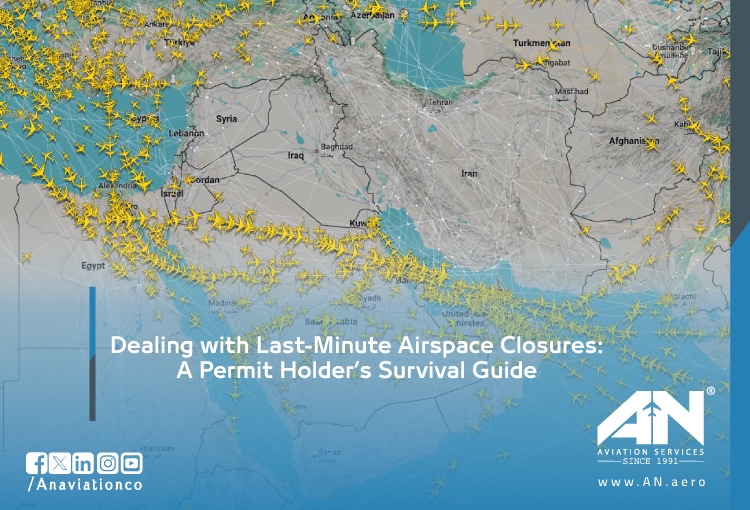
In modern aviation, even the most carefully planned route can disappear overnight. Operators may secure all necessary overflight and landing permits only to discover hours before departure that the airspace they planned to use is no longer available.
Last-minute airspace closures have become a growing operational challenge for flight planners, charter operators, and cargo missions worldwide. A route that was safe and approved yesterday may be restricted today due to political tensions, military activity, or environmental hazards.
Understanding how airspace closures affect permits and knowing how to respond quickly can mean the difference between a minor delay and a grounded aircraft.
The New Normal: Airspace Can Close Without Warning
In the past decade, aviation authorities have increasingly issued sudden airspace restrictions with little notice.
Geopolitical tensions, regional conflicts, and security concerns have made last-minute airspace closures a regular occurrence across several global corridors.
For permit holders, this creates a critical risk, Your approved permit is only valid for a specific route. If the airspace associated with that route closes, the permit effectively expires with it.
What Triggers Last-Minute Airspace Closures?
Airspace restrictions can happen for many reasons, often with minimal warning.
1- Geopolitical Conflict and Military Escalation
Political instability or military conflict can lead governments to immediately restrict or close portions of their airspace. These closures are often implemented for security reasons and may remain active for days or even months.
2- Military Exercises and Sudden NOTAMs
Military training exercises frequently require temporary airspace restrictions. These are usually communicated through NOTAMs, sometimes issued only hours before they become active.
3- Natural Disasters and Volcanic Activity
Events such as volcanic eruptions, earthquakes, or severe weather systems can create hazardous flying conditions. Aviation authorities may respond by closing specific airways or entire flight information regions.
What Happens to Your Permit When Airspace Closes?
The Permit Expires with the Route
Most overflight and landing permits are tied to:
- A specific route
- A specific date
- A defined time window (often 6–24 hours)
If the approved route becomes unavailable due to airspace closures, the permit becomes void. Operators cannot simply reroute through another corridor without obtaining new approvals.
The Revalidation Challenge
Obtaining new permits for an alternative route can take time.
Under normal conditions, permit approvals may require 2–5 business days, depending on the country and authority involved.
If a closure occurs on a weekend or public holiday, the delay may be even longer. Some civil aviation authorities operate only during limited weekday hours, meaning operators may be forced to wait until the next business day to submit new applications.
Pinpoint Problems & Your Action Plan
Situation 1: Your Destination Airspace Suddenly Closes Mid-Flight
Pinpoint:
You are already en route when ATC informs you that your destination airspace has just closed. You do not have permits for an alternative route.
Action Plan:
Immediately contact your flight support provider’s 24/7 emergency operations desk. Experienced aviation service providers maintain direct emergency contacts with aviation authorities and can coordinate real-time rerouting. In some situations, authorities may grant special status approvals for urgent diversions.
Situation 2: Your Flight Is Scheduled Tomorrow but the Airspace Just Closed
Pinpoint:
Political unrest causes the country you planned to overfly to announce an immediate closure.
Action Plan:
Activate your contingency routing plan immediately. Before departure, operators should identify alternative corridors with potential permit applications ready to submit. Having pre-planned alternatives can reduce delays dramatically.
Situation 3: An Urgent AOG Recovery Mission Needs a Flexible Permit
Pinpoint:
You are planning an aircraft-on-ground recovery mission, and the fastest route crosses a country with unpredictable airspace status.
Action Plan:
Where permitted, apply for approvals that allow multiple aircraft registrations or alternate tail numbers. Some aviation authorities allow operators to include alternates within a single application, ensuring operational continuity if the primary aircraft becomes unavailable.
Situation 4: A NOTAM Closes Your Planned Airway Hours Before Departure
Pinpoint:
Your permit is approved, but a new NOTAM closes the specific airway you planned to use.
Action Plan:
Check the flexibility of your permit. Some authorities allow a limited timing buffer around the approved slot, but routing changes typically require a new application. Acting immediately is critical to minimize delays.
The Emergency Permit Process: When Minutes Matter
When a genuine emergency occurs, aviation authorities may activate expedited approval procedures.
What Qualifies as an Emergency?
Authorities may issue rapid permits in situations such as:
- Medical emergencies requiring immediate diversion
- Aircraft mechanical failures affecting safety
- Fuel shortages requiring route deviation
- Natural disasters or severe weather
- Political instability impacting flight safety
The 30-Minute to 2-Hour Window
In legitimate emergency cases, overflight permits can sometimes be issued in 30 minutes to two hours, depending on:
- Time of day
- Authority availability
- Complexity of the request
- Existing relationships with aviation authorities
Information Authorities Need Immediately
To process an emergency permit quickly, authorities typically require:
- Aircraft registration and type
- Full flight details and routing
- Entry and exit points
- Estimated times
- Crew information
- Documentation supporting the emergency
Having this information prepared in advance can significantly reduce processing time.
How AN Aviation Services Handles Last-Minute Airspace Closures?
Managing last-minute airspace closures requires constant monitoring, fast communication, and established authority relationships.
AN Aviation Services supports operators with:
- 24/7 Real-Time Monitoring and Alerts: Continuous tracking of NOTAMs, geopolitical developments, and airspace restrictions worldwide.
- Direct Authority Relationships: Established contacts with civil aviation authorities help accelerate permit processing when time is critical.
- Pre-Vetted Documentation: Prepared documentation ensures that permit requests can be submitted immediately when route changes occur.
Preparation Is the Best Defense
In today’s aviation environment, airspace closures are no longer rare disruptions they are an operational reality.
Flight operators who prepare contingency routes, maintain strong aviation support partnerships, and act quickly when closures occur can minimize delays and keep missions moving safely.
When routes disappear without warning, having the right support and strategy in place ensures your operations remain resilient.
FAQ
How do I get an emergency overflight permit when airspace closes?
Contact your flight support provider immediately so they can request an expedited permit from the relevant aviation authority.
What happens to my permit if the country closes its airspace?
The permit becomes invalid because it is tied to a specific route and time window.
How quickly can I get a new permit after a last-minute closure?
Emergency permits may be issued in 30 minutes to 2 hours, while normal reapplications can take several business days.
Which countries process emergency permits fastest?
Processing speed depends on the authority, time of day, and the urgency of the situation.
Can I fly through closed airspace in a genuine emergency?
Only if the relevant aviation authority grants a special emergency authorization.
Are there alternative routes pre-approved for common conflict zones?
Not usually, but experienced flight support providers maintain contingency routing options.
What documents do I need for an urgent permit reapplication?
Aircraft registration, flight details, crew information, routing, and proof of the emergency situation.