

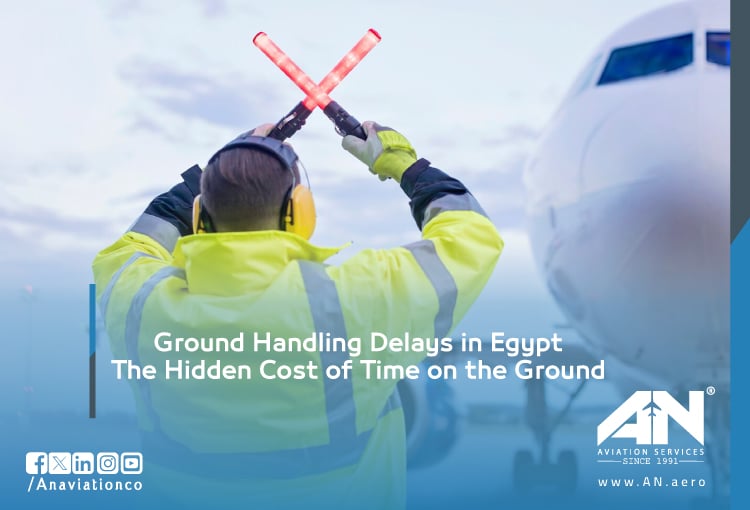
For aircraft operators, time on the ground is rarely treated as a major cost until a delay starts affecting the rest of the operation.
An aircraft waiting for fuel, a gate, baggage handling, passenger boarding, pushback, or another turnaround service may appear to be experiencing only a small operational inconvenience. But a few extra minutes on the ground can quickly translate into higher fuel consumption, additional crew costs, reduced aircraft utilization, missed slots, and delays to subsequent sectors.
This is why ground handling is about more than simply getting an aircraft serviced between arrival and departure. Efficient ground handling can directly influence how much an operator spends on every rotation.
For operators flying into or out of Egypt, where multiple parties may need to coordinate around a single aircraft turnaround, choosing the right ground handling partner can make a meaningful difference.
What Do We Mean by Ground Delays?
A ground delay is any period when an aircraft remains on the ground longer than planned before departure or during the turnaround process.
Depending on the operation, this can include:
- Waiting for a parking position or gate
- Delays in passenger or baggage handling
- Fueling delays
- Slow aircraft cleaning or servicing
- Loading and unloading delays
- Pushback or towing delays
- Poor coordination between service providers
- Extended taxi-out times before takeoff
Not every ground delay has the same cause. However, they all affect the efficiency of the aircraft and can disrupt the wider flight schedule.
For operators, the goal is to identify avoidable ground delays and keep every turnaround moving as efficiently as possible.
The Real Numbers That Should Worry You
The financial impact of delays becomes easier to understand when time is converted into money.
EUROCONTROL‘s recommended economic values put the average cost of an at-gate delay at €166 per minute, while short taxiing delays are estimated at €62 per minute and the broader taxi delay figure reaches €182 per minute. These values are based on European airline delay-cost research and are adjusted to 2022 prices.
The U.S. provides another indication of how expensive aviation delays can become. An FAA/Nextor study estimated the total annual cost of flight delays in the United States at approximately $33 billion in 2019, covering direct costs to airlines and passengers as well as lost demand and indirect economic costs.
These figures should not be interpreted as a fixed price tag for every delayed aircraft. Aircraft type, airport, operation, delay duration, fuel prices, crew structure, and network effects all change the calculation.
But they demonstrate an important operational principle: A minute is not simply a minute when an aircraft is sitting on the ground.
Why Does Ground Handling Matter to Operators?
Operators cannot control everything that affects a flight.
Fuel prices can change. Weather can disrupt schedules. Airspace restrictions can appear unexpectedly. Airports can become congested.
But operators can influence how efficiently the aircraft is handled once it reaches the ground.
A well-coordinated turnaround can help reduce unnecessary waiting between arrival and departure. That means coordinating the services an aircraft needs before it arrives, having the right equipment and personnel available, and making sure different suppliers are working toward the same departure target.
For operators flying into Egypt, this coordination is particularly important when several services need to be arranged at the same airport.
AN Aviation Services provides ground handling and flight support in Egypt, with services covering passenger handling, ramp services, flight operations, load control, cargo and mail, representation, and supervision. The company states that it has provided ground-handling services to international airlines in Egypt for more than 30 years.
The objective is not simply to complete each individual task. It is to complete the entire turnaround efficiently.
Pinpoint the Problem: Where Is Your Money Being Wasted?
1. You Underestimate the Cost of Small Delays
A five- or ten-minute delay can seem insignificant when viewed in isolation. The problem is that operators rarely experience only one isolated delay.
A few minutes added to one turnaround can affect the aircraft’s next departure. That can create additional crew time, reduce the available operating window, affect connections, or contribute to a chain of subsequent delays.
Action: Calculate Your True Cost of Delay
Instead of asking, “How much did the ground handler charge us?”, ask: “How much did the delay cost the entire operation?”
Your calculation should consider:
- Additional fuel consumption
- Crew costs
- Ground handling charges
- Aircraft utilization
- Maintenance implications
- Passenger-related costs
- Missed slots or operational restrictions
- The impact on the next flight
The result will give you a much clearer picture of the financial value of reducing ground time.
2. Fuel Waste From Inefficient Ground Operations
Fuel is not only consumed during flight.
Extended taxiing, unnecessary engine operation, and inefficient turnaround coordination can all contribute to additional fuel consumption.
EUROCONTROL’s data distinguishes between at-gate and taxiing delay costs, demonstrating that where and how a delay occurs can materially affect its cost.
Action: Choose Ground Handlers Who Minimize Ground Time
When comparing ground handling providers, do not evaluate them only on the quoted handling fee. Ask how they manage:
- Fuel coordination
- Ramp operations
- Passenger handling
- Baggage
- Pushback and towing
- Aircraft servicing
- Turnaround supervision
- Communication between teams
The cheapest handling invoice is not necessarily the lowest-cost handling solution.
3. Multiple Vendors Can Create Coordination Delays
An aircraft turnaround can involve multiple parties.
Fuel providers, ground handlers, catering teams, passenger service teams, airport representatives, transport providers, and other suppliers may all need to work around the same departure time.
When responsibilities are fragmented, communication gaps can become another source of delay.
Action: Use a One-Stop Ground Handler
Where practical, consolidating services through one experienced ground handling partner can simplify coordination.
Instead of the operator having to manage multiple conversations and timelines, one ground support team can coordinate the required services around the aircraft’s planned arrival and departure.
This is particularly valuable for operators conducting charter, business aviation, cargo, or other non-scheduled operations where turnaround requirements can vary from flight to flight.
4. Ground Delays Cost More Than Fuel
It is easy to focus on the most visible cost. But a ground delay can affect much more than the fuel bill.
Longer ground times can:
- Increase crew duty time
- Reduce aircraft utilization
- Disrupt subsequent rotations
- Create additional passenger handling requirements
- Increase the risk of missed departure slots
- Put pressure on maintenance schedules
- Create operational knock-on effects
- Damage the passenger experience
Action: Reduce Ground Time to Control the Entire Cost
The goal should not be to save a few minutes for the sake of a faster turnaround.
The goal is to reduce avoidable ground time across the operation.
That means identifying where delays occur, measuring them consistently, and working with ground handling partners that can demonstrate reliable turnaround performance.
What Ground Delays Really Cost?
The cost of a ground delay goes far beyond the minutes shown on the aircraft’s turnaround timeline.
A delay can create additional costs across the operation, including:
- Fuel: Longer taxiing and extended ground time can increase fuel consumption.
- Crew: Delays can put additional pressure on crew duty hours and scheduling.
- Aircraft utilization: More time on the ground means less productive flying time.
- Maintenance: Delays can disrupt planned maintenance schedules and aircraft availability.
- Subsequent flights: A late departure can create a chain of delays across the aircraft’s next rotations.
- Passenger experience: Longer waiting times can affect customer satisfaction and operational reputation.
For operators, the real cost is therefore not simply how many minutes the aircraft was delayed, but what those minutes trigger across the rest of the operation.
This is why reducing avoidable ground time should be viewed as a cost-control strategy, not simply a way to improve punctuality.
What About U.S. Delay Costs?
The FAA/Nextor research provides another useful benchmark. Its widely cited analysis estimated the total annual cost of U.S. flight delays at $33 billion in 2019, including airline and passenger costs, lost demand, and indirect economic effects.
The figure is not an Egypt-specific benchmark, nor is it a direct measure of ground handling costs.
Instead, it illustrates the wider economic principle: flight delays create costs across the entire aviation system.
The Hidden Costs You Don’t See on the Invoice
A ground delay does not always appear as a separate line item saying “delay cost.” Some of the biggest consequences appear elsewhere in the operation.
A delayed aircraft may spend longer occupying airport resources. Crew schedules may become tighter. The next flight may have less turnaround time available. Passengers may spend longer waiting. A schedule that looked efficient on paper can gradually lose its margin.
Supply-chain and fleet-related disruptions can create similar knock-on effects. Aging fleets, maintenance requirements, spare-parts constraints, and aircraft availability can all make recovery from an operational delay more difficult.
This is why looking at the handling invoice alone can give operators an incomplete picture of the cost.
The Real Impact on Your Operation
- Crew: A longer turnaround can put pressure on crew duty schedules and reduce the flexibility available later in the rotation.
- Aircraft Utilization: An aircraft that spends more time on the ground is not generating the same productive flying time it could under a more efficient turnaround.
- Network and Schedule: A delay on one sector can become a problem for the next sector. The longer the disruption continues, the more difficult it can become to recover the original schedule.
- Passenger Experience: Passengers rarely distinguish between a fuel delay, baggage delay, ramp delay, or coordination failure.
They simply experience a flight that is late.
For operators, repeated delays can therefore affect customer satisfaction and the perception of operational reliability.
How Professional Ground Handling Can Reduce Delay Costs?
Professional ground handling is not simply about completing individual services. It is about coordinating those services around the aircraft’s operational timeline.
1. Digital Fuel Coordination
Fueling is one of the critical components of an aircraft turnaround. Delays can occur when fuel requirements, arrival information, uplift instructions, equipment availability, and payment or credit arrangements are not coordinated in advance.
A professional ground support operation can coordinate fueling requirements before and during the aircraft’s arrival, reducing unnecessary waiting and communication gaps.
2. Coordinated Turnarounds
The most efficient turnaround is one where the required services are planned around the aircraft’s actual schedule.
That can include coordinating:
- Passenger and baggage handling
- Ramp services
- Fueling
- Aircraft cleaning
- Catering
- Ground transportation
- Pushback and towing
- Flight operations support
- Local airport coordination
AN Aviation’s ground handling operation covers multiple operational areas, including passenger service, ramp service, flight operations, load control, cargo and mail, representation, and supervision.
The benefit of this integrated approach is straightforward: fewer gaps between services and clearer responsibility for the turnaround.
What AN Aviation Services Does Differently?
For an operator arriving in Egypt, ground handling is only one part of the flight support requirement.
AN Aviation Services combines ground handling with other operational support, including overflight and landing permits, flight planning, aviation fuel, catering, charter services, cargo handling, weather information, and hotel accommodation.
The company states that it operates as a ground handling agent and flight support company in Egypt and the UAE, with operations covering all types of aircraft and offices at airports across Egypt and the UAE.
That integrated approach can help operators reduce the number of separate parties involved in coordinating an arrival or departure. And when every minute on the ground can affect the economics of a rotation, coordination is not a minor detail. It is part of the cost-control strategy.